

5G Core Enterprise
release time:May 7, 2026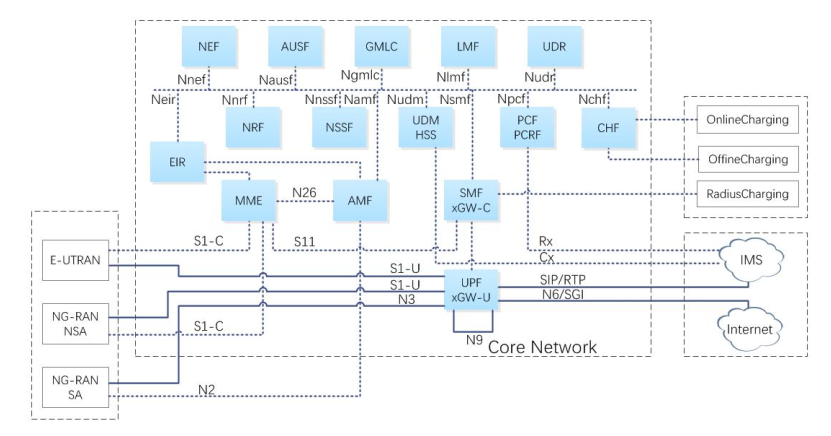
The core network software includes fundamental network elements such as AMF, SMF, AUSF, UDM, and UPF, complying with 3GPP protocol standards. Each network element supports major standard interfaces requiredby telecom operators.
The equipment (as an example, suggest user to buy server locally) adopts a miniaturized server design with a compact form factor.
5GC Network Functions List
Component Name | Full English Name | Function Description |
5GC-AMF | Access and Mobility Management Function | Manages access control and mobility, acting as the termination point for RAN control plane signaling. |
5GC-SMF | Session Management Function | Handles session management, IP address allocation, and controls policy enforcement for the UPF. |
5GC-UPF | User Plane Function | The anchor point for user data, responsible for packet routing, forwarding, and QoS handling. |
5GC-UDM | Unified Data Management | Manages subscriber data, generates authentication credentials, and handles user identification. |
5GC-AUSF | Authentication Server Function | Executes the authentication process with the User Equipment (UE) to ensure network security. |
5GC-PCF | Policy Control Function | Provides policy rules to control plane functions to govern network behavior and QoS. |
5GC-OAM | Operations, Administration, and Maintenance | Provides the management interface for system configuration, fault monitoring, and maintenance. |
5GC-IMS | IP Multimedia Subsystem | Delivers multimedia services (voice, video) over IP, enabling VoNR/VoLTE capabilities. |
High Availability and Carrier-Grade Reliability
Lopcomm's commercial 5G Core is engineered for mission-critical operations, featuring a fully redundant, geo-distributed architecture. It supports seamless failover and state synchronization across multiple data centers, ensuring 99.999% service availability. This robust design guarantees uninterrupted connectivity and service continuity for enterprise customers, even in the event of hardware failures or network disruptions.