

5G Core Open
release time:May 7, 2026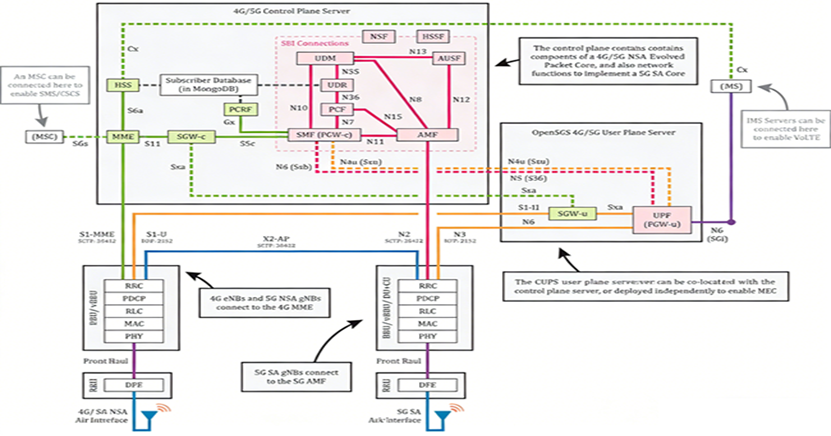
The core network software implements a complete set of 5G System (5GS) architecture based on the open-source project. It includes essential network functions such as AMF, SMF, AUSF, UDM, PCF, and UPF, strictly adhering to 3GPP Release 15/16 protocol standards. This implementation provides a transparent, modular codebase that supports standard interfaces (e.g., NGAP, SBI), making it an ideal platform for protocol compliance verification, academic research, and private network prototyping.
The equipment adopts a lightweight and compact server design, optimized for flexibility and ease of deployment. Unlike heavy-duty carrier hardware, this unit is designed to run efficiently on commercial off-the-shelf (COTS) hardware. We recommend users procure standard local servers that meet the basic computing requirements, allowing for cost-effective experimentation and agile integration in lab or edge environments.
5GC Network Functions List
Component Name | Full English Name | Function Description |
5GC-AMF | Access and Mobility Management Function | Manages access control and mobility, acting as the termination point for RAN control plane signaling. |
5GC-SMF | Session Management Function | Handles session management, IP address allocation, and controls policy enforcement for the UPF. |
5GC-UPF | User Plane Function | The anchor point for user data, responsible for packet routing, forwarding, and QoS handling. |
5GC-UDM | Unified Data Management | Manages subscriber data, generates authentication credentials, and handles user identification. |
5GC-AUSF | Authentication Server Function | Executes the authentication process with the User Equipment (UE) to ensure network security. |
5GC-PCF | Policy Control Function | Provides policy rules to control plane functions to govern network behavior and QoS. |
5GC-OAM | Operations, Administration, and Maintenance | Provides the management interface for system configuration, fault monitoring, and maintenance. |
Flexible Architecture
This open-source edition prioritizes modularity and standards compliance over carrier-grade redundancy. Designed as a versatile software platform, it allows developers and researchers to inspect, modify, and extend network functionalities. While it lacks the geo-redundant failover capabilities of commercial carrier cores, it offers a robust, fully functional 5G environment perfect for validating new algorithms, testing UE devices, and deploying small-scale private networks with high cost-efficiency.